Active Silver: Understanding the Silver Ion Behind Ionic Silver

When it comes to silver, there is much more to the story than simply asking “How much silver is in the bottle?”

You may have seen products described using terms such as Active Silver, Ionic Silver, Colloidal Silver, Silver Ions, Silver Nanoparticles or simply Silver 10ppm.
But what does “active” silver actually mean?
The answer starts with understanding the different forms silver can take — and, importantly, the role of the silver ion (Ag⁺).
What Is Active Silver?
The term Active Silver is increasingly used to describe silver in a form that is available to interact with its surrounding environment.

From a scientific perspective, one of the most important forms is the silver ion, Ag⁺.
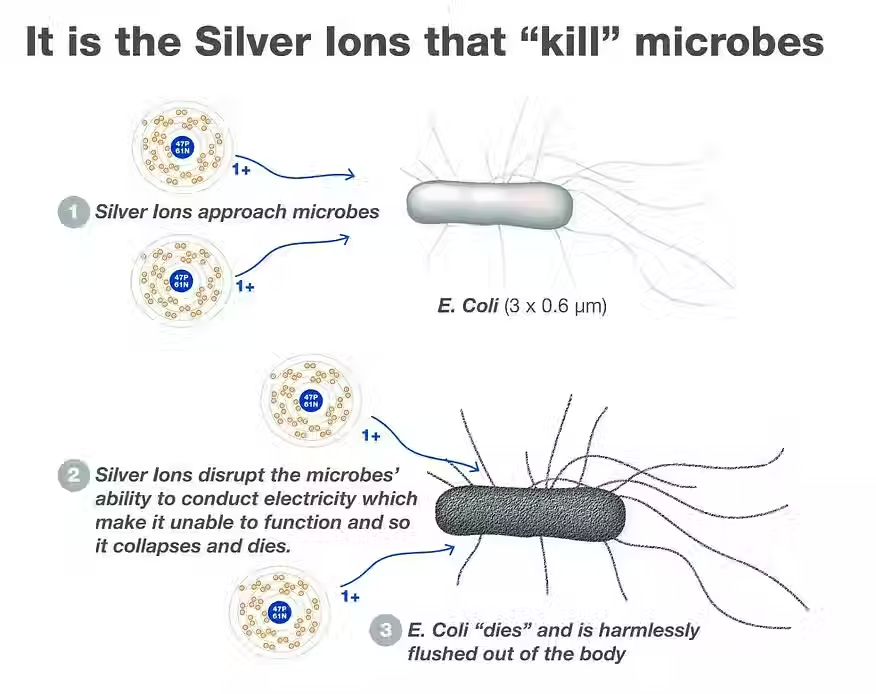
Silver ions are electrically charged silver atoms. Unlike metallic silver, which is relatively stable, silver ions are chemically reactive and can interact with biological molecules.
This distinction is particularly important when discussing the antimicrobial properties historically associated with silver.
The science behind silver ions
Research from scientists at Rice University investigated one of the long-standing questions surrounding silver nanoparticles: are the particles themselves responsible for killing bacteria, or is something else happening?
Their research found that silver ions, rather than the silver nanoparticles themselves, were the key toxic species responsible for bacterial death in their experiments.
The researchers found that when silver nanoparticles were prevented from releasing silver ions, their toxicity to bacteria was dramatically reduced. When silver ions were available, antibacterial activity was observed at much lower concentrations. (news2.rice.edu)
In other words:
Silver particle ≠ necessarily active silver
Silver ion (Ag⁺) = the chemically active form associated with antimicrobial activity
This is one of the reasons understanding the difference between ionic silver and colloidal silver matters.
A note about colloidal silver
This isn’t about saying that colloidal silver products are “bad” or that they don’t have a place.
Good-quality colloidal silver can contain both silver particles and silver ions, with the balance depending on how the product is manufactured and formulated. The presence of silver ions is important because, as the research discussed above demonstrates, it is the silver ion (Ag⁺) that plays a significant role in the antimicrobial activity associated with silver.
The important point is to understand what you’re actually buying.
Colloidal silver and ionic silver are not necessarily interchangeable terms. A colloidal silver product may contain suspended silver particles alongside ionic silver, while a product specifically formulated as ionic silver is intended to provide silver in its ionic form.
So this isn’t a case of “ionic silver good, colloidal silver bad.”
It’s about understanding the chemistry, the concentration and the form of silver present — and making an informed comparison between products.
At HealthWest UK, we believe buyers should have access to clear information so they can decide which type of silver product is appropriate for their own requirements.
So, What Part of Silver Is “Active”?
The simplest answer is:
The silver ion — Ag⁺
Silver ions can interact with components of microbial cells, including proteins and other cellular structures. Research has associated these interactions with disruption of essential cellular processes.
Rice University’s research demonstrated the importance of silver ion availability in the antibacterial activity of silver-based systems. (news2.rice.edu)
This helps explain why simply quoting a particle size or using terminology such as “nano silver” does not, by itself, tell the whole story.
The chemistry and availability of the silver matter.
The scientific literature also describes interactions between ionic silver and sulphur-containing groups in proteins, which can interfere with important cellular functions. (repository.rice.edu)
Active Silver vs Ionic Silver
This is where terminology can become confusing.
Active Silver is not, by itself, a scientific measurement of concentration.
It is a descriptive term.
Ionic Silver, on the other hand, describes silver present in ionic form.
For buyers looking at silver products, therefore, it is worth looking beyond the marketing terminology and asking:
What form of silver is being supplied?
What is the stated concentration?
Is the product described as ionic silver or colloidal silver?
Is there independent testing available?
What exactly does the stated ppm represent?
Is the manufacturer transparent about the product composition?
These questions can provide much more useful information than a product name alone.
Why 20ppm Matters
HealthWest UK supplies IS20 Pure Ionic Silver at 20ppm, alongside higher-concentration ionic silver products at 50ppm and 100ppm. (Healthwest UK)
This makes concentration an important point of comparison.
For example:
10ppm = 10 parts per million
20ppm = 20 parts per million
Therefore, on a like-for-like ppm basis:
20ppm contains twice the stated silver concentration of 10ppm.
That’s a simple mathematical difference of 2:1.
So when comparing products, don’t be distracted by terminology such as “Active Silver” alone.
Look at the numbers.
If two comparable products are offered at the same price, a 20ppm solution contains twice the stated silver concentration of a 10ppm solution.
That makes ppm an important consideration when evaluating value.
HealthWest UK IS20: Pure Ionic Silver at 20ppm
HealthWest UK’s IS20 Pure Ionic Silver is formulated as an ionic silver solution and is supplied at 20ppm.
The HealthWest range also extends beyond IS20, with:
IS20 — Pure Ionic Silver 20ppm
IS50 — Pure Ionic Silver 50ppm
IS100 — Pure Ionic Silver 100ppm
This gives customers, practitioners and professional users a choice of silver concentrations depending on their intended application. (Healthwest UK)
For wholesale customers, this also provides greater flexibility when developing products or sourcing silver-based ingredients for manufacturing and formulation.
Don’t Just Look at the Name — Look at the Silver
The growing use of terms such as Active Silver demonstrates how important silver’s active properties have become in consumer awareness.
But an informed buyer should look beyond the label.
A product described as “active” isn’t necessarily telling you:
How much silver is present?
What form is the silver in?
How much of that silver is ionic?
Has the product been independently tested?
These are much more meaningful questions.
At HealthWest UK, we believe transparency matters.
That’s why our Ionic Silver range clearly identifies the concentration of each product, allowing customers and wholesale buyers to compare products on a straightforward ppm basis.
From 20ppm to 100ppm — Choose Your Silver Concentration
HealthWest UK’s Ionic Silver range has been developed for customers looking for clearly specified silver solutions rather than vague descriptions.
Whether you’re looking for 20ppm Ionic Silver, a higher-strength 50ppm Ionic Silver, or 100ppm Practitioner Strength Ionic Silver, the concentration is clearly stated.
For manufacturers, formulators, practitioners and wholesale buyers, this makes it easier to identify the product that fits their requirements.
And for consumers, it provides something equally important:
clarity.
Active Silver: The Takeaway
The phrase Active Silver may sound simple, but the science behind silver is considerably more interesting.
The important distinction is between metallic silver, silver particles and silver ions (Ag⁺).
Research from Rice University provided compelling evidence that, in the silver nanoparticle systems they studied, silver ions were the critical species responsible for antibacterial activity, rather than the nanoparticles themselves. (news2.rice.edu)
So when evaluating an ionic silver product, look beyond the marketing terminology.
Look at the form of silver.
Look at the concentration.
Look for independent testing.
And compare like with like.
With HealthWest UK’s range starting at 20ppm and extending through 50ppm to 100ppm, customers have clearly defined concentrations to choose from.
Because when it comes to silver, the numbers matter.
Frequently Asked Questions
What is Active Silver?
“Active Silver” is a descriptive term commonly used to refer to silver that is available to interact chemically with its environment. In the context of antimicrobial silver research, the silver ion (Ag⁺) is particularly important.
Is Ionic Silver the same as Active Silver?
Not necessarily. “Active Silver” is a descriptive marketing term, whereas “ionic silver” describes silver in ionic form. Silver ions are the chemically active species that have been associated with antimicrobial activity in scientific research.
What did the Rice University research discover?
Rice University researchers investigated the antibacterial activity of silver nanoparticles and found that silver ions, rather than the nanoparticles themselves, were responsible for the antibacterial toxicity observed in their experiments. (news2.rice.edu)
Is 20ppm twice as strong as 10ppm?
In terms of the stated silver concentration, yes. A 20ppm solution contains twice the amount of silver per unit volume as a 10ppm solution. However, ppm alone does not establish the biological effectiveness of a product, and different formulations can behave differently.
What is IS20?
IS20 is HealthWest UK’s Pure Ionic Silver at 20ppm. HealthWest UK also supplies 50ppm and 100ppm Ionic Silver products. (Healthwest UK)
Why should I compare ppm when buying Ionic Silver?
ppm provides a straightforward way of comparing the stated concentration of silver between products. For example, 20ppm represents twice the stated silver concentration of 10ppm, making concentration an important factor when comparing products of similar formulation and volume.
Does a higher ppm automatically mean a better product?
Not necessarily. Concentration is only one factor. Product composition, silver form, purity, manufacturing processes, intended application and independent testing are also important considerations.